Collecting Farm Data at Scale
Collecting farm data across a network of hundreds of farms required a move away from spreadsheets and email towards a structured system. The goal was to enable consistent submission, validation, and real-time visibility, without increasing the burden on farmers or programme managers.

The Problem
A research organisation needed to collect in-season data from farms across England. However, their existing approach relied on a patchwork of spreadsheets, forms, and email.
This created friction at every stage. Data arrived in inconsistent formats, making it difficult to validate or compare. Farmers were asked to engage with different tools and processes, depending on the request. Internally, there was no clear view of who had completed submissions and who hadn’t.
As a result, reporting became a manual, time-consuming task, requiring consolidation from multiple sources. As the programme scaled to hundreds of farms, these inefficiencies became increasingly difficult to manage.
The Requirement
The organisation needed a system that was simple for farmers, but structured enough to support scale.
At its core, the solution had to:
Provide a mobile-friendly way for farmers to submit data
Store and validate responses in a central system
Offer clear visibility across all participating farms
Ensure a secure, authenticated environment
Scale easily as the programme expanded
The Approach
To address this, a structured data collection workflow was implemented using Exchange.
Surveys were configured to match the exact requirements of the programme, allowing farmers to submit data through a simple, mobile-friendly interface. Behind the scenes, each submission is validated and stored in a central system, removing the need for manual checking and consolidation.
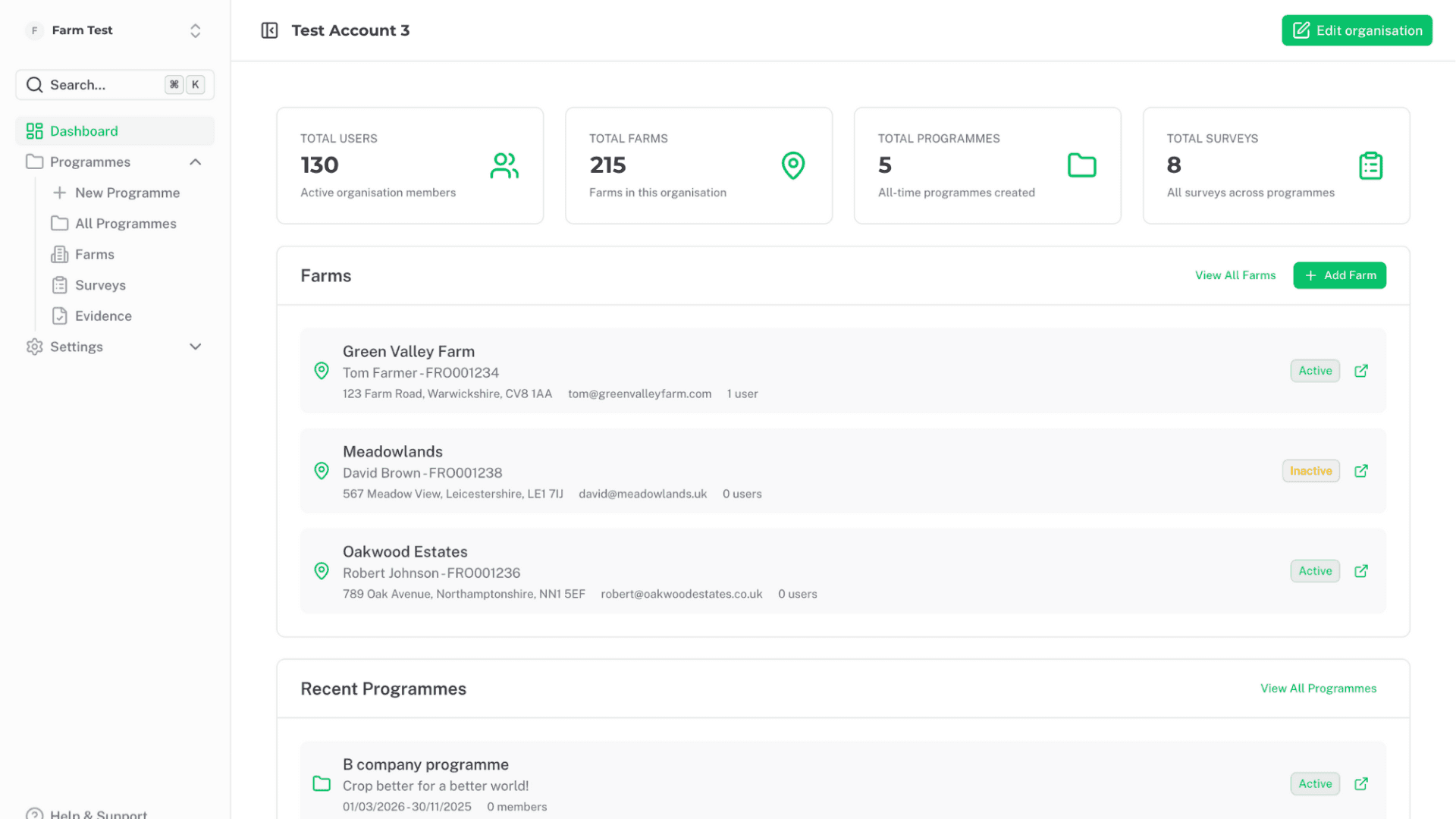
Programme managers can track progress in real time, with full visibility across all participating farms. Communication is handled within the platform, using built-in tools to prompt submissions and maintain engagement.
The entire system was designed and deployed within a one-month window, aligned to seasonal programme timelines. In doing so, Exchange replaced a set of disconnected tools with a single, controlled environment for data collection and review.
The Outcome
The shift to a single platform streamlined both the farmer experience and internal workflows.
One platform replaces spreadsheets, forms, and email
Farmers submit data more consistently, from any device
Programme managers track participation in real time
Data validation becomes structured and repeatable
Reporting is significantly faster to produce
Crucially, the organisation retains full control over workflows and communication, without adding complexity.
The Impact
Data collection moved from fragmented to structured, from manual to validated, and from unclear to fully visible.
The result was not more data, but usable data.