Designing Sustainability Programmes Growers Will Actually Adopt
Sustainability practices and motivations in growers.
Data Source: DEFRA - Farm Practices Survey - February Edition
The food supply chain is increasingly under pressure to reduce emissions, but effective sustainability programmes need to start by understanding what growers are currently doing on farm and more importantly, their motivations driving those actions. These trends can offer a useful benchmark for where support is most likely to drive engagement.
Chart 1. Proportion of Holdings Currently Taking Action to Reduce GHG Emissions.
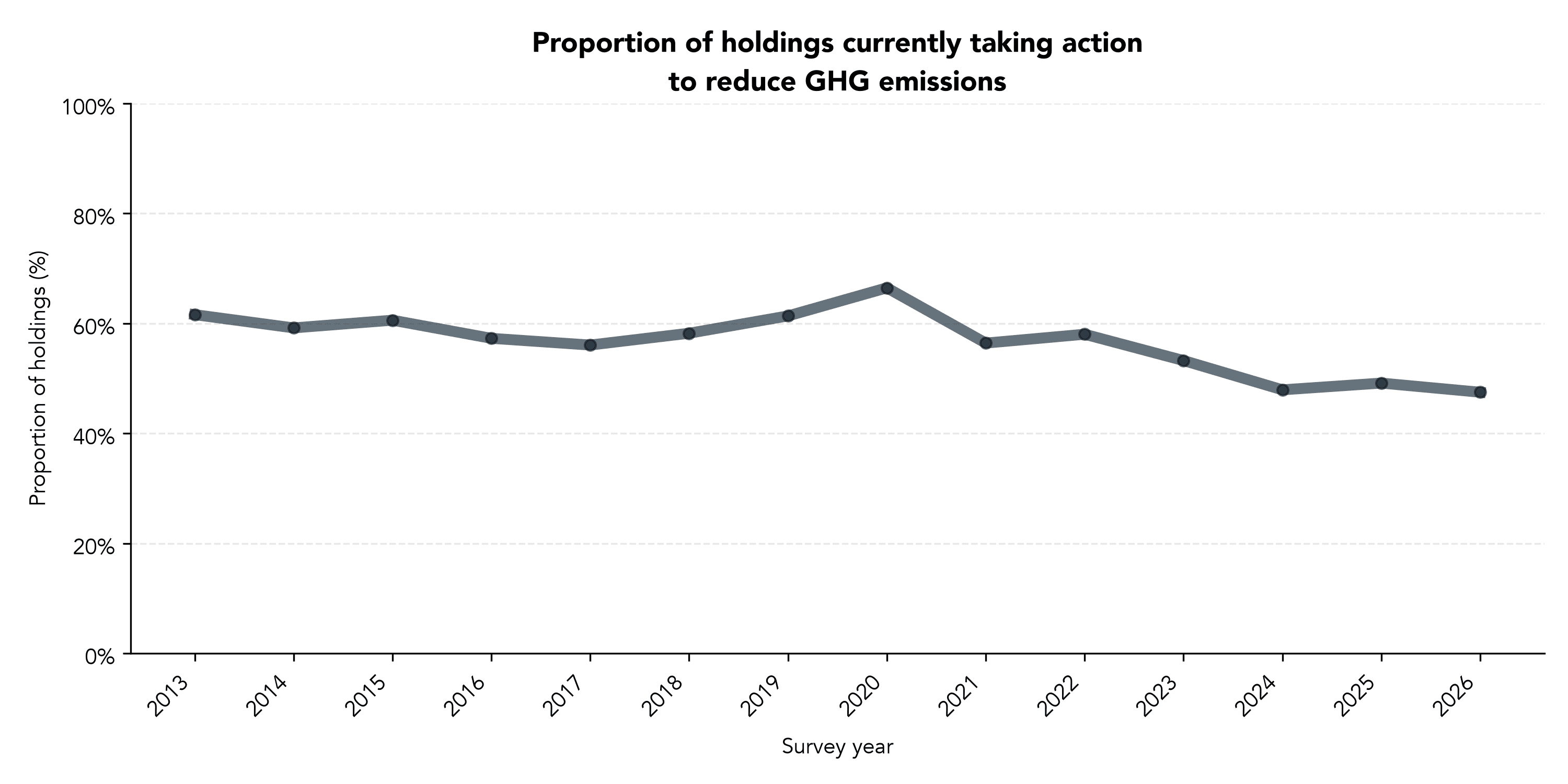
Despite pressures leading to an increased focus on reducing GHG in the supply chain, for growers, the coverage of actions taken on farm is at best steady or indeed declining.
Chart 2. Trends in Motivations for Reducing GHG Emissions. (Holdings Currently Taking Action)

Looking at what motivates growers, good business practice is the only constant, highlighting that the biggest motivator is perhaps improving their own business rather than being driven by external pressures. Regulation as a motivator has fallen dramatically over the past few years (dropping from 50% in 2013 to 26% in 2026), while profitability and environmental concern have remained relatively stable. Market demand has shown little increase as a motivating factor, we expect this to become a far larger motivator in the next few years.
Together, these trends indicate that growers are most likely to adopt sustainability practices when they make good farming and good business sense. Regulation may encourage change, but long-term adoption appears to be driven by improvements that benefit the farm itself.
Chart 3: Trends in GHG Reduction Actions (Key Actions). (Holdings Currently Taking Action)

Some of the popular methods used by growers to reduce emissions are around recycling and improving energy efficiency, with other major practices including reducing tillage intensity and N fertiliser accuracy such as through variable rate N applications.
Cultivation changes to reduce tillage intensity are a recent addition to the survey and have increased in popularity every year since 2024 (from 64% to 68% of respondents) alongside adding clover into grassland showing one of the largest increases since 2013 of 14%.
These trends demonstrate how on-farm sustainability continues to change, providing valuable insight for supply chains looking to develop targeted, evidence-based sustainability programmes.
Looking to build a more effective sustainability programme? We help supply chains design grower initiatives that encourage adoption, capture validated practice data, and provide trusted reporting for customers and stakeholders.